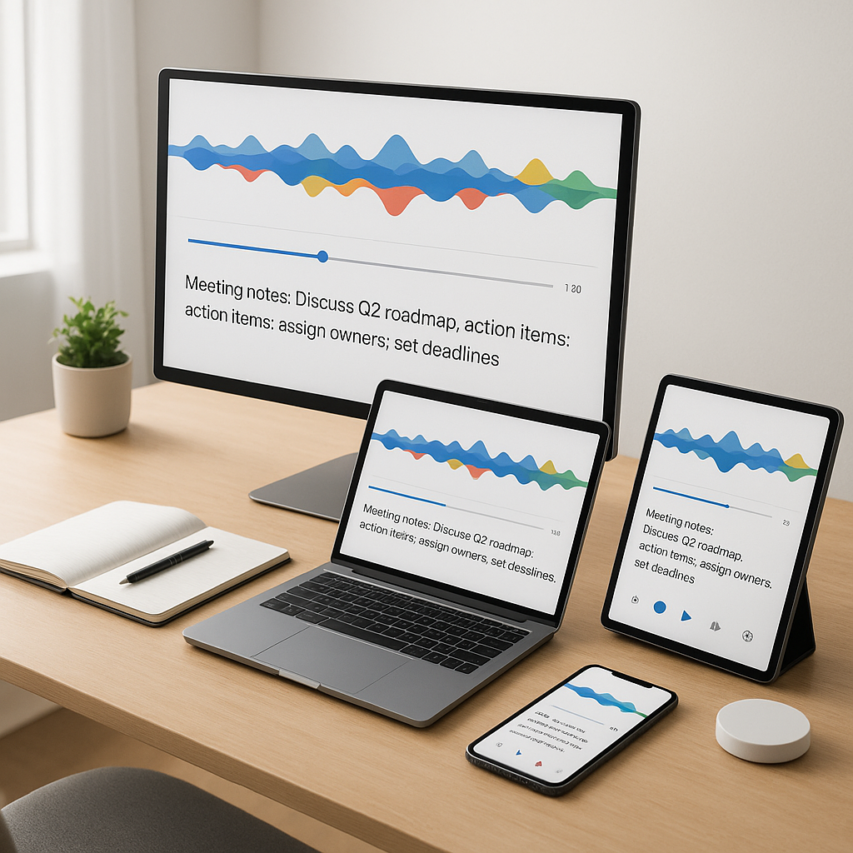
Google has revolutionized how we interact with technology through voice, transforming from simple google text to speech capabilities into sophisticated AI-powered communication systems. What began as basic computer-generated voices has evolved into natural-sounding speech synthesis and remarkably accurate voice recognition that powers everything from smart assistants to enterprise transcription solutions. Today’s Google speech technologies seamlessly bridge the gap between human communication and digital interfaces, making technology more accessible and productive for millions of users worldwide.
Understanding Google’s comprehensive speech technology ecosystem has become essential for anyone looking to enhance productivity, improve accessibility, or build voice-enabled applications. Whether you’re a content creator seeking efficient text to speech google solutions, a business professional needing reliable meeting transcription, or a developer integrating voice capabilities into applications, Google’s suite of tools offers powerful options for every use case. The platform’s continuous AI improvements have made voice interactions more natural and reliable than ever before.
This comprehensive guide will walk you through Google’s complete speech technology landscape, from consumer-friendly google speech to text features to enterprise-grade google cloud speech to text APIs. You’ll discover practical implementation strategies, real-world applications, and expert insights to help you leverage these powerful voice AI solutions effectively in your personal and professional projects.
Understanding Google’s Speech Technology Ecosystem
Google’s speech technology ecosystem represents one of the most comprehensive and sophisticated voice AI platforms available today. Built on decades of machine learning research and powered by neural networks trained on massive datasets, Google’s speech technologies offer developers and businesses powerful tools for converting speech to text and text to speech across multiple languages and use cases.
The foundation of Google’s speech capabilities lies in its advanced deep learning models that can understand natural language patterns, accents, and contextual nuances. These technologies power everything from Google Assistant to enterprise-grade transcription services, making them accessible to both individual users and large organizations seeking to integrate voice functionality into their applications.
Core Speech Technologies Overview
Google’s speech technology stack consists of several interconnected services that work together to provide comprehensive voice AI solutions. The primary components include Google Cloud Speech-to-Text, which converts audio into written text with remarkable accuracy, and Google Text-to-Speech, which generates natural-sounding speech from written content.
Google speech to text technology utilizes advanced machine learning algorithms to process audio in real-time or from recorded files. The service supports over 125 languages and variants, automatically detects spoken languages, and can handle multiple speakers in a single audio stream. Features like automatic punctuation, profanity filtering, and speaker diarization make it suitable for professional transcription needs.
The text to speech google service employs WaveNet technology to produce human-like voice synthesis. This neural network-based approach creates more natural intonation and pronunciation compared to traditional concatenative methods. Users can choose from multiple voice types, adjust speaking rates, and even customize pitch to match specific brand requirements.
Google Cloud Speech-to-Text offers enhanced features for enterprise applications, including custom vocabulary support, adaptation for specific domains, and enhanced models for phone calls and video content. The service also provides confidence scores for transcriptions, allowing applications to handle uncertain results appropriately.
Consumer vs Enterprise Solutions
Google structures its speech technologies to serve both consumer and enterprise markets with distinct feature sets and pricing models. Consumer-facing solutions typically focus on ease of use and integration with personal devices, while enterprise offerings emphasize scalability, customization, and advanced analytics.
Consumer applications of google text to speech include accessibility features in Android devices, voice responses in Google Assistant, and reading assistance in Chrome browser. These implementations prioritize quick response times and seamless user experiences across Google’s ecosystem of products and services.
Enterprise solutions provide more sophisticated capabilities for business applications. Google Cloud Speech-to-Text offers batch processing for large audio files, streaming recognition for real-time applications, and enhanced models trained on specific industries like healthcare and telecommunications. Enterprise customers also gain access to detailed usage analytics, custom model training, and dedicated support resources.
The pricing structure reflects these different use cases, with consumer applications often included in device costs or service subscriptions, while enterprise solutions follow usage-based pricing models that scale with processing volume and feature requirements.
Integration Capabilities and Platforms
Google’s speech technologies integrate seamlessly across multiple platforms and development environments. The company provides comprehensive APIs, SDKs, and documentation that enable developers to implement voice functionality in web applications, mobile apps, and desktop software.
Platform compatibility extends across iOS, Android, Windows, macOS, and Linux systems through REST APIs and gRPC interfaces. Developers can choose between cloud-based processing for maximum accuracy and on-device processing for privacy-sensitive applications. The google text to talk functionality works particularly well in mobile environments where users expect immediate voice feedback.
Integration options include direct API calls, pre-built libraries for popular programming languages, and no-code solutions through Google Cloud Console. For businesses requiring specialized transcription capabilities, tools like Sozai demonstrate how third-party applications can leverage Google’s speech technologies while adding unique features for specific workflows.
The ecosystem also supports webhook integrations, allowing applications to receive real-time notifications when speech processing completes. This architecture enables sophisticated workflows where speech recognition triggers automated responses or data processing pipelines, making Google’s speech technologies valuable components in larger business automation strategies.
Google Text-to-Speech: Converting Text to Natural Voice
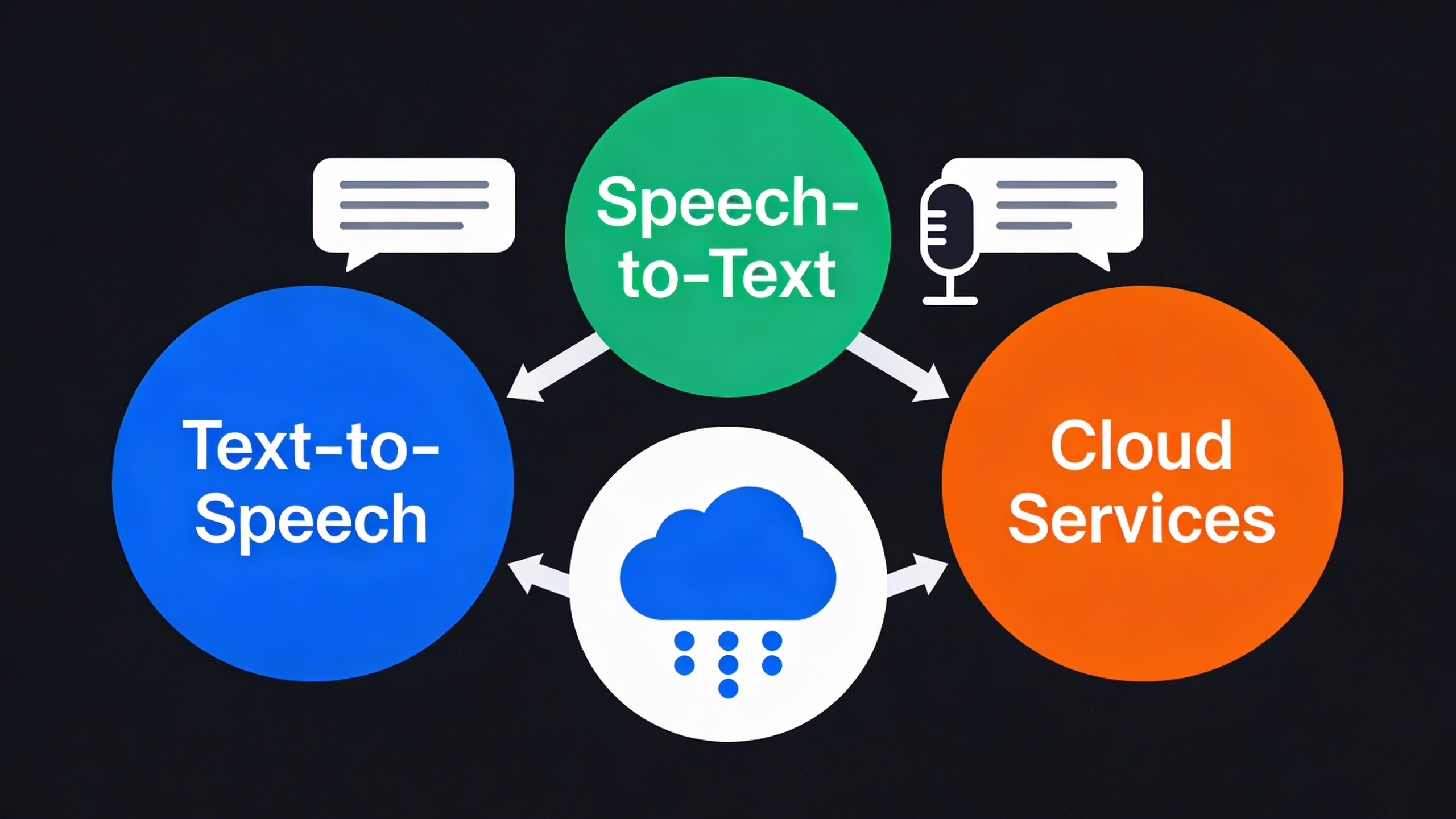
Google’s text-to-speech technology transforms written content into natural-sounding audio, enabling applications to communicate with users through synthesized voice output. This powerful service bridges the gap between digital text and human-like speech, making content accessible across diverse platforms and user needs.
Text-to-Speech Features and Capabilities
Google text to speech delivers remarkable versatility through its comprehensive feature set. The service supports over 220 voices across more than 40 languages and variants, ensuring global accessibility for applications worldwide. Neural voice models produce exceptionally natural speech patterns, incorporating proper intonation, emphasis, and rhythm that closely mimics human conversation.
The technology excels in various practical applications. E-learning platforms utilize text to speech google services to create audio versions of written materials, helping students with different learning preferences. Customer service systems integrate these capabilities to provide spoken responses during phone interactions, while accessibility tools convert web content into audio for visually impaired users.
Advanced features include Speech Synthesis Markup Language (SSML) support, allowing developers to control pronunciation, speaking rate, pitch, and volume. This granular control enables fine-tuning of voice output to match specific brand requirements or user preferences. The service also handles multiple text formats, from plain text to rich HTML content, automatically managing punctuation and formatting cues.
Voice Selection and Customization Options
Voice selection significantly impacts user experience and brand perception. Google’s text-to-speech platform offers Standard, WaveNet, and Neural2 voice types, each providing different levels of naturalness and computational efficiency. WaveNet voices deliver superior quality through deep neural network processing, while Neural2 voices represent the latest advancement in speech synthesis technology.
Customization extends beyond simple voice selection. Developers can adjust speaking rates from 0.25x to 4x normal speed, modify pitch levels, and control audio encoding formats including MP3, LINEAR16, and OGG_OPUS. These options ensure compatibility with various playback systems and bandwidth requirements.
| Voice Type | Quality Level | Best Use Case | Processing Speed |
|---|---|---|---|
| Standard | Good | High-volume applications | Fastest |
| WaveNet | Excellent | Premium user experiences | Moderate |
| Neural2 | Superior | Professional content creation | Slower |
Custom voice creation allows organizations to develop unique vocal identities. Through Google Cloud’s Custom Voice feature, businesses can train models using their own audio recordings, creating distinctive brand voices that maintain consistency across all customer touchpoints.
Implementation Methods and Best Practices
Successful google text to speech implementation requires careful planning and optimization. The Cloud Text-to-Speech API provides multiple integration pathways, including REST APIs, client libraries, and command-line tools. Developers should choose implementation methods based on their technical requirements, scalability needs, and existing infrastructure.
Authentication setup forms the foundation of secure implementation. Service account keys enable server-to-server communication, while API keys work well for client-side applications with proper security measures. Implementing proper error handling ensures graceful degradation when network issues or quota limits occur.
Performance optimization involves strategic caching of frequently requested audio content. Since identical text inputs produce consistent audio outputs, storing generated speech files reduces API calls and improves response times. Implementing audio streaming for longer content prevents user waiting periods and creates smoother experiences.
Cost management becomes crucial for high-volume applications. Understanding pricing tiers helps organizations choose appropriate voice types for different use cases. Standard voices cost less per character than WaveNet or Neural2 options, making them suitable for basic notifications, while premium voices enhance customer-facing content.
Integration with complementary services amplifies functionality. Combining google text to speech with google speech to text creates bidirectional voice interfaces, enabling natural conversation flows in applications. This pairing proves particularly valuable for voice assistants, dictation systems, and interactive voice response platforms.
Testing across diverse scenarios ensures reliable performance. Validate pronunciation accuracy for industry-specific terminology, test various text lengths to optimize processing times, and verify audio quality across different playback devices. Regular monitoring of usage patterns helps identify optimization opportunities and prevents unexpected quota overages.
Google Speech-to-Text: Transforming Voice into Written Content
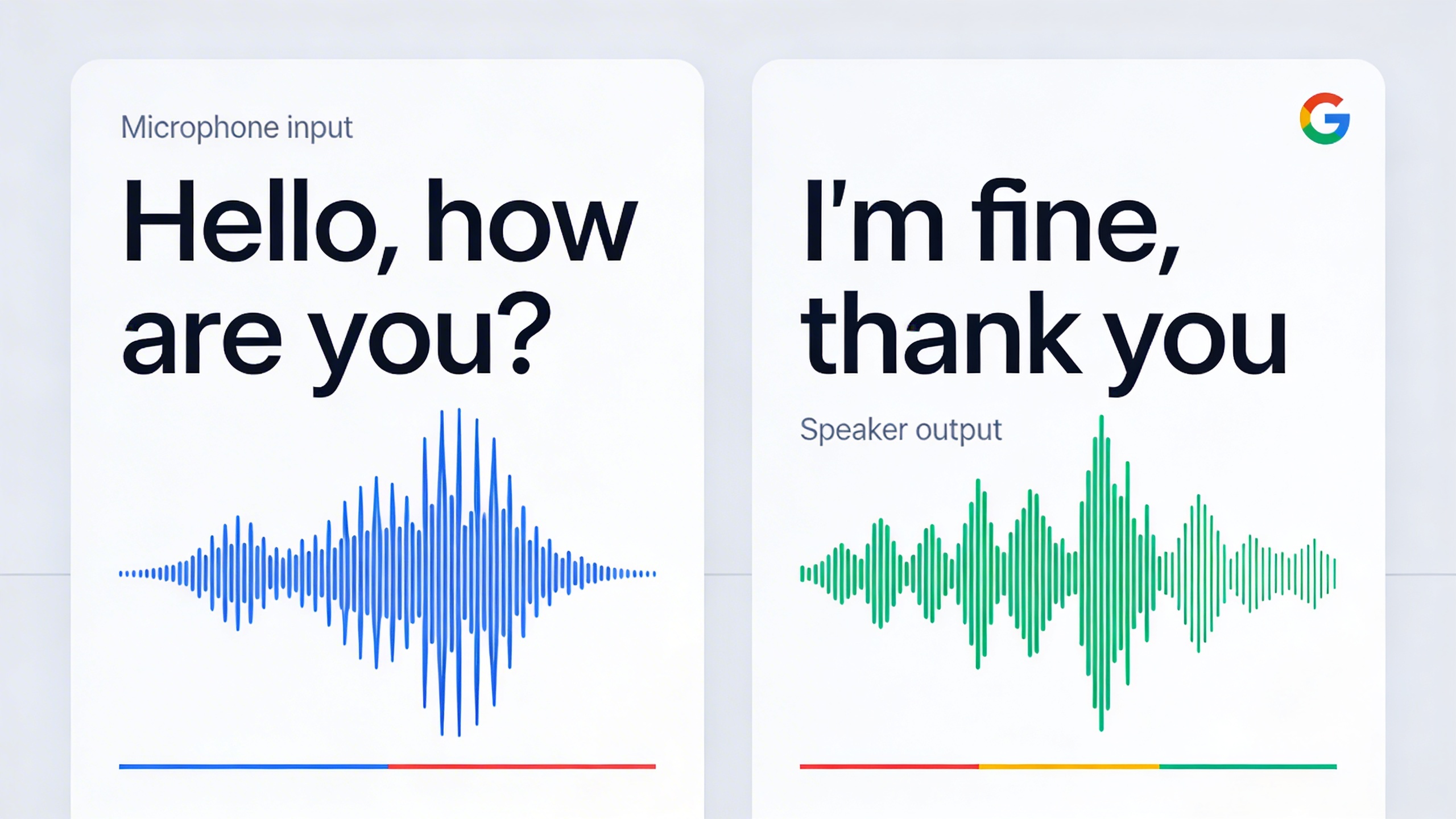
Google’s Speech-to-Text API represents a significant advancement in voice recognition technology, converting spoken language into accurate written text across numerous applications. This powerful service leverages Google’s machine learning expertise to deliver reliable transcription capabilities for developers, businesses, and content creators seeking to integrate voice-to-text functionality into their workflows.
The technology behind Google cloud speech to text has evolved dramatically, incorporating neural network models that understand context, punctuation, and even speaker emotions. Unlike basic dictation tools, Google’s solution provides enterprise-grade accuracy with support for streaming audio, pre-recorded files, and real-time conversation transcription.
Speech Recognition Accuracy and Languages
Google speech to text achieves impressive accuracy rates, typically ranging from 85% to 95% depending on audio quality, speaker clarity, and language complexity. The service excels particularly well with clear audio recordings and standard accents, making it suitable for professional transcription tasks, meeting documentation, and content creation.
Language support spans over 125 languages and variants, including major global languages like English, Spanish, French, German, Japanese, and Mandarin Chinese. Regional dialects receive specific attention, with Google continuously updating models to recognize accent variations from different geographic regions. This extensive language coverage makes the platform valuable for international businesses and multilingual content creators.
The accuracy improves significantly when users provide context through custom vocabulary lists and domain-specific terminology. Medical professionals, legal teams, and technical industries can enhance recognition rates by training the system with specialized jargon and industry-specific terms that standard models might misinterpret.
Real-time vs Batch Processing
Google offers two distinct processing approaches to accommodate different use cases and technical requirements. Real-time processing enables live transcription during phone calls, video conferences, or live streaming events. This streaming capability processes audio as it arrives, providing immediate text output with minimal latency.
Batch processing handles pre-recorded audio files, offering higher accuracy through multiple analysis passes. This method works well for podcast transcription, interview documentation, and archival content conversion. Batch processing supports longer audio files and provides more detailed output, including speaker identification and enhanced punctuation.
For applications requiring immediate feedback, such as voice assistants or live captioning, real-time processing delivers results within 100-300 milliseconds. Batch processing typically takes 25-50% of the audio duration to complete, making it ideal for non-urgent transcription tasks where accuracy takes priority over speed.
Content creators and professionals working with recorded audio often benefit from tools like Sozai, which streamlines the transcription process by combining Google’s speech recognition capabilities with user-friendly interfaces designed for efficient workflow management.
Advanced Features and Customization
Google cloud speech to text provides sophisticated customization options that extend beyond basic transcription. Speaker diarization identifies and labels different speakers in multi-person conversations, essential for meeting transcripts and interview documentation. This feature distinguishes between up to six speakers automatically, though accuracy depends on distinct voice characteristics and clear audio separation.
Automatic punctuation insertion adds periods, commas, and question marks based on speech patterns and pauses, significantly improving readability without manual editing. The service also supports profanity filtering, timestamp generation, and confidence scoring for each transcribed word, enabling quality control and selective editing.
Custom model training allows organizations to optimize recognition for specific vocabularies, accents, or acoustic environments. Companies can upload domain-specific audio samples and terminology lists to create specialized models that outperform generic solutions for their particular use cases.
Audio enhancement features automatically adjust for background noise, multiple speakers, and varying audio quality. The system can process audio from different sources, including phone calls, video files, and streaming media, adapting its algorithms to optimize recognition performance for each input type.
Integration capabilities enable seamless connection with existing workflows through REST APIs, client libraries, and webhook notifications. Developers can implement custom triggers, automated workflows, and real-time processing pipelines that transform voice content into actionable text data across various business applications and content management systems.
Google Cloud Speech APIs: Enterprise-Grade Solutions
Google Cloud Speech APIs represent the enterprise-tier evolution of Google’s consumer speech technologies, offering robust, scalable solutions for businesses requiring high-volume voice processing capabilities. These APIs provide the same underlying technology that powers Google Assistant and other consumer products, but with enterprise-focused features including enhanced security, customization options, and guaranteed service level agreements.
The enterprise APIs differ significantly from consumer versions in their ability to handle massive concurrent requests, support custom vocabularies, and integrate seamlessly with existing business workflows. Organizations can leverage these APIs to build sophisticated voice-enabled applications, automate transcription workflows, and create accessible user interfaces that serve millions of users simultaneously.
Cloud Speech-to-Text API Features
The Google Cloud Speech to Text API delivers professional-grade transcription capabilities with features specifically designed for enterprise environments. The API supports over 125 languages and variants, enabling global businesses to process voice content from diverse user bases without language barriers.
Real-time streaming transcription allows applications to process live audio feeds with minimal latency, making it ideal for customer service platforms, live captioning systems, and voice-controlled applications. The API can handle audio files up to 480 minutes in length for batch processing, accommodating lengthy meetings, interviews, and recorded content.
Advanced features include speaker diarization, which identifies and separates different speakers in multi-person conversations, and automatic punctuation insertion that produces readable transcripts without manual editing. The API also supports custom vocabulary enhancement, allowing businesses to improve accuracy for industry-specific terminology, product names, and technical jargon.
Security features meet enterprise requirements with data encryption in transit and at rest, compliance with major industry standards including SOC 2 and ISO 27001, and options for data residency control. These capabilities make the google speech to text API suitable for healthcare, financial services, and other regulated industries.
Cloud Text-to-Speech API Capabilities
The Google Cloud text to speech API transforms written content into natural-sounding audio using advanced neural network models. The service offers over 380 voices across more than 50 languages, providing extensive options for creating localized audio content that resonates with target audiences.
WaveNet voices represent the premium tier of the google text to speech service, delivering human-like speech quality that significantly outperforms traditional concatenative synthesis methods. These voices excel in applications requiring high audio quality, such as audiobook production, e-learning platforms, and customer-facing voice interfaces.
The API supports Speech Synthesis Markup Language (SSML), enabling fine-grained control over pronunciation, emphasis, speaking rate, and pitch variations. Developers can customize voice characteristics to match brand requirements or create distinct personas for different use cases within the same application.
Audio output formats include MP3, WAV, and OGG, with configurable sampling rates and bit depths to optimize file sizes for specific delivery channels. The API can generate audio files or stream content directly to applications, providing flexibility for both real-time and batch processing scenarios.
Pricing Models and Usage Optimization
Google Cloud Speech APIs employ usage-based pricing models that scale with business needs while offering predictable cost structures for budget planning. The google cloud speech to text API charges per minute of processed audio, with different rates for standard and premium features like enhanced models and speaker diarization.
Cost optimization strategies include implementing intelligent audio preprocessing to reduce unnecessary API calls, using appropriate quality settings for different use cases, and leveraging batch processing for non-time-sensitive transcription tasks. Organizations can achieve significant savings by processing audio files during off-peak hours when possible.
The text to speech google API pricing depends on the number of characters processed and voice type selected. Standard voices offer cost-effective solutions for high-volume applications, while WaveNet voices provide premium quality at higher rates for applications where audio quality directly impacts user experience.
Enterprise customers benefit from committed use discounts, sustained use discounts, and custom pricing arrangements for large-scale deployments. Proper usage monitoring and optimization can reduce costs by 30-50% compared to unmanaged implementations, making these powerful APIs accessible for businesses of all sizes.
Practical Applications and Use Cases
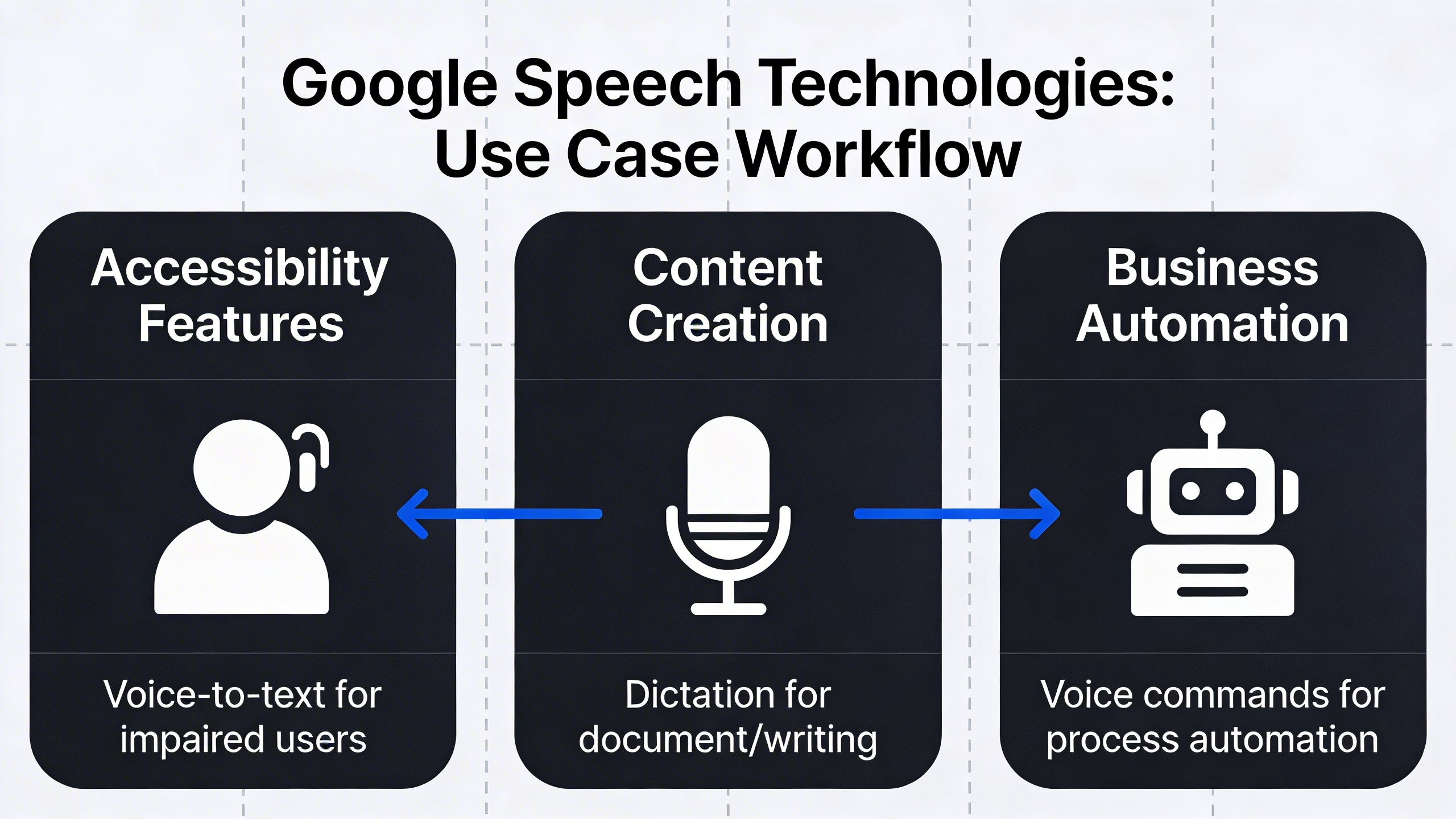
Google’s speech technologies have transformed how we interact with digital content across industries. From breaking down accessibility barriers to revolutionizing content creation workflows, these voice AI solutions deliver measurable improvements in productivity and user experience. Understanding real-world applications helps organizations identify opportunities to integrate speech technology effectively.
Accessibility and Assistive Technology
Speech technology serves as a bridge for users with visual impairments, motor disabilities, and learning differences. Google text to speech enables screen readers to convert written content into natural-sounding audio, making websites, documents, and applications accessible to millions of users worldwide. Educational institutions leverage these capabilities to support students with dyslexia or reading challenges, allowing them to consume textbook content through audio playback.
Voice-controlled interfaces powered by google speech to text technology enable hands-free navigation for users with mobility limitations. Smart home systems, mobile applications, and computer interfaces respond to voice commands, eliminating the need for traditional input methods. Healthcare facilities implement voice-activated systems that allow medical professionals to update patient records without touching potentially contaminated surfaces, improving both accessibility and safety protocols.
Assistive communication devices utilize text to speech google technology to give voice to individuals with speech impairments. These solutions range from simple communication boards to sophisticated applications that learn user preferences and speaking patterns over time.
Content Creation and Media Production
Media professionals rely on speech technology to streamline content production workflows. Podcast creators use google cloud speech to text services to generate accurate transcripts, enabling better SEO performance and accessibility compliance. Video producers implement automated captioning systems that reduce post-production time while ensuring content reaches broader audiences.
Voice-over production has been revolutionized by advanced text-to-speech capabilities. Marketing teams create multilingual audio content without hiring multiple voice actors, while e-learning platforms generate consistent narration across extensive course libraries. News organizations use these tools to produce audio versions of written articles, expanding their content distribution channels.
Content creators working with interview recordings or meeting documentation benefit from high-accuracy transcription services. Tools like Sozai complement Google’s technologies by providing specialized features for content creators who need reliable voice-to-text conversion with advanced editing capabilities.
Audio book production leverages sophisticated text-to-speech engines to create preliminary versions of narrated content, allowing publishers to evaluate pacing and flow before investing in professional voice talent.
Business Process Automation
Enterprise organizations integrate google text to talk solutions into customer service workflows, creating automated phone systems that provide natural-sounding responses to common inquiries. Call centers implement real-time transcription to assist agents with accurate note-taking and compliance monitoring during customer interactions.
Meeting documentation becomes effortless with automated transcription systems that convert spoken discussions into searchable text records. Project management teams use these capabilities to generate action items and meeting summaries without dedicating resources to manual note-taking.
Voice-enabled data entry transforms field operations across industries. Warehouse workers update inventory systems through voice commands, while healthcare professionals dictate patient observations directly into electronic health records. These implementations reduce data entry errors and improve operational efficiency.
Legal professionals utilize speech-to-text technology for deposition transcription and document dictation, significantly reducing turnaround times for case preparation. Financial services leverage voice authentication combined with speech recognition to create secure, hands-free banking experiences that verify customer identity while processing verbal instructions.
Implementation Guide and Best Practices
Successfully deploying Google’s speech technologies requires careful planning and systematic implementation. This comprehensive guide walks you through the essential steps, optimization strategies, and troubleshooting techniques to maximize your voice AI solutions.
Getting Started with Google Speech Technologies
Begin your implementation by setting up the proper development environment and authentication credentials. Create a Google Cloud Platform account and enable the Speech-to-Text API and Text-to-Speech API services through the console. Generate service account keys and configure your environment variables to ensure secure API access.
For basic google text to speech implementation, start with simple audio file generation using the REST API. Begin with short text snippets to test voice quality and language settings before scaling to longer content. When implementing google speech to text functionality, use high-quality audio samples during initial testing to establish baseline accuracy rates.
Structure your application architecture to handle asynchronous processing for longer audio files. Implement proper error handling and retry mechanisms from the beginning, as network connectivity and API rate limits can affect performance. Consider using streaming APIs for real-time applications where immediate response is critical.
Optimization Techniques for Better Results
Audio quality significantly impacts google cloud speech to text accuracy. Ensure your input audio meets recommended specifications: 16 kHz sample rate for telephony applications or 44.1 kHz for high-fidelity content. Use lossless audio formats when possible, and implement noise reduction preprocessing to improve recognition rates.
Configure speech recognition models based on your specific use case. Select domain-specific models for medical, legal, or technical content to achieve higher accuracy. Enable automatic punctuation and speaker diarization features when transcribing multi-speaker conversations or formal presentations.
For text to speech google applications, optimize voice selection based on your target audience and content type. Neural voices provide more natural-sounding output but consume additional processing resources. Implement SSML markup to control pronunciation, speaking rate, and emphasis for critical terms or phrases.
Batch processing multiple requests can improve efficiency and reduce costs. Group similar content types together and process them during off-peak hours when possible. Implement caching mechanisms for frequently requested audio outputs to minimize API calls and improve response times.
Troubleshooting Common Issues
Authentication errors are among the most frequent implementation challenges. Verify that your service account has the necessary permissions and that API keys are properly configured in your environment. Check that billing is enabled on your Google Cloud project, as speech services require active billing accounts.
When google text to talk functionality produces unclear audio, examine your SSML markup for syntax errors or conflicting voice parameters. Test different voice models and speaking rates to find the optimal configuration for your content type. Monitor API response codes to identify quota limits or service disruptions.
Low transcription accuracy often stems from poor audio quality or incorrect model selection. Analyze your audio input for background noise, multiple speakers, or technical terminology that might require specialized language models. Consider using tools like Sozai for preprocessing and quality enhancement before sending audio to Google’s APIs.
Network timeout errors typically occur with large file uploads or extended processing times. Implement exponential backoff retry logic and consider breaking large files into smaller segments. Monitor your API usage quotas and request limit increases before reaching capacity constraints that could disrupt service availability.
Comparing Google Speech Technologies with Alternatives
When evaluating speech technology solutions, understanding how Google’s offerings stack up against competitors helps ensure you select the right platform for your specific needs. This comparison examines key factors that influence technology selection decisions.
Strengths and Limitations
Google’s speech technologies excel in several critical areas. The google speech to text service delivers exceptional accuracy across multiple languages, with particularly strong performance in noisy environments and conversational speech. Google’s neural network models, trained on vast datasets, provide robust recognition capabilities that often outperform traditional speech recognition systems.
The text to speech google platform offers natural-sounding voices with advanced prosody and emotion modeling. WaveNet technology produces human-like speech quality that surpasses many competitors, especially for customer-facing applications. Additionally, Google’s cloud infrastructure ensures reliable scaling and global availability.
However, Google’s solutions have notable limitations. Privacy-conscious organizations may prefer on-premises alternatives, as Google processes audio data in the cloud. Pricing can become significant for high-volume applications, and customization options may be limited compared to specialized providers. Some industries requiring specific vocabulary or accents might find better accuracy with domain-focused competitors.
When to Choose Google vs Other Providers
Select Google when you need proven accuracy, extensive language support, and seamless integration with existing Google Cloud services. The google cloud speech to text API works exceptionally well for applications requiring real-time transcription, multilingual support, or integration with Google Workspace tools.
Consider alternatives when privacy regulations require on-premises processing, when you need highly specialized vocabulary recognition, or when cost optimization is paramount. Microsoft Azure Speech Services offers competitive accuracy with strong enterprise integration, while AWS Transcribe provides excellent cost efficiency for batch processing. For mobile applications prioritizing offline functionality, dedicated apps like Sozai offer reliable voice-to-text capabilities without cloud dependencies.
Amazon Polly excels for applications requiring extensive voice customization, while IBM Watson Speech provides superior performance for specific industry verticals like healthcare or legal services.
Future-Proofing Your Speech Technology Investment
Google’s substantial investment in AI research positions its speech technologies favorably for long-term viability. The company’s continuous model improvements and feature additions demonstrate commitment to maintaining competitive advantages. Regular updates to the google text to speech and recognition engines ensure compatibility with evolving user expectations.
However, avoid vendor lock-in by implementing abstraction layers that allow switching between providers. Consider hybrid approaches that combine multiple services based on specific use case requirements. Monitor emerging technologies like edge computing and improved on-device processing, which may shift optimal deployment strategies over time.
Evaluate total cost of ownership beyond initial implementation, including ongoing maintenance, scaling costs, and potential migration expenses. The google text to talk ecosystem’s integration benefits may justify higher costs for organizations already invested in Google’s platform, while standalone applications might benefit from more focused alternatives.