In today’s fast-paced digital world, the ability to convert spoken words into written text has become a game-changing necessity. Audio to text transcription transforms everything from important business meetings and academic lectures to personal voice memos into searchable, editable documents. Whether you’re a journalist conducting interviews, a student reviewing recorded lectures, or a business professional managing countless hours of meeting recordings, transcription from audio has evolved from a luxury service into an essential productivity tool.
The transcription landscape has undergone a remarkable transformation with the rise of artificial intelligence and machine learning technologies. Modern ai audio transcription services can process hours of content in minutes, offering accuracy rates that rival human transcriptionists at a fraction of the cost. From simple transcription audio video conversion to sophisticated multi-speaker recognition, today’s solutions cater to diverse needs across industries.
This comprehensive guide will walk you through everything you need to know about audio transcription services. You’ll discover the fundamental technologies powering these tools, explore various service types and pricing models, learn best practices for optimal results, and gain insights into choosing the perfect solution for your specific needs. We’ll also examine the exciting future developments that promise to make audio to transcript conversion even more powerful and accessible.
Understanding Audio Transcription: Fundamentals and Applications
What Is Audio Transcription and How It Works
Audio transcription is the process of converting spoken words from audio recordings into written text format. This technology transforms voice data from meetings, interviews, lectures, and other audio sources into searchable, editable documents that can be easily shared and archived.
The transcription from audio process relies on sophisticated speech recognition algorithms that analyze sound waves and identify patterns corresponding to specific words and phrases. Modern systems use artificial intelligence and machine learning to improve accuracy by understanding context, speaker accents, and industry-specific terminology. When you upload an audio file, the software breaks down the recording into smaller segments, processes each portion through neural networks, and reconstructs the content as coherent text.
AI audio transcription has revolutionized this field by offering near real-time processing capabilities. These systems continuously learn from vast datasets of human speech, enabling them to handle multiple speakers, background noise, and various audio qualities with increasing precision. The technology can distinguish between different voices in group conversations and even add timestamps for easy navigation through longer recordings.
Common Use Cases Across Industries
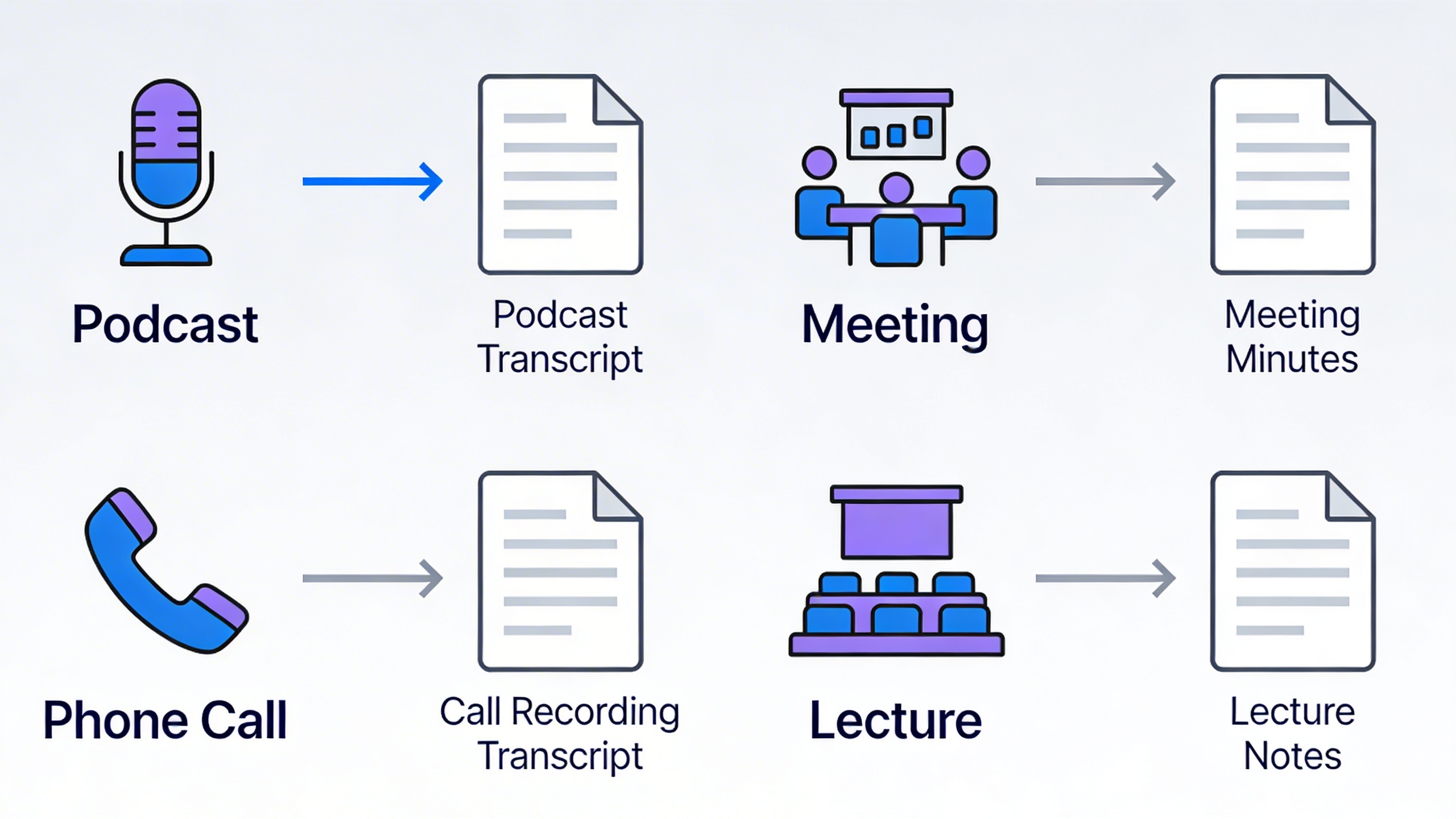
Professional environments have embraced transcription audio video solutions to streamline workflows and improve documentation processes. In corporate settings, executives use audio to transcript services to convert board meetings, client calls, and brainstorming sessions into actionable meeting minutes and follow-up materials.
Healthcare professionals rely heavily on transcription services to document patient consultations, medical procedures, and treatment plans. Doctors can dictate notes during or after appointments, creating comprehensive medical records without interrupting patient care. This approach significantly reduces administrative burden while maintaining detailed documentation standards.
Legal professionals use audio to text transcription for depositions, court proceedings, and client interviews. Accurate transcripts serve as crucial evidence and reference materials throughout case preparation. Law firms often require verbatim transcription that captures every word, pause, and speaker identification for courtroom proceedings.
Academic institutions leverage transcription technology for research interviews, lecture recordings, and student accessibility services. Researchers can focus on conducting interviews while knowing their conversations will be accurately documented for later analysis. Universities also use transcription to create study materials and support students with hearing impairments.
Media and entertainment companies utilize transcription for content creation, subtitle generation, and podcast production. Journalists transcribe interviews for article writing, while content creators convert video discussions into blog posts and social media content. This multi-format approach maximizes content value across different platforms.
Benefits of Converting Audio to Text
The primary advantage of audio transcription lies in enhanced accessibility and information retention. Written transcripts make content available to individuals with hearing difficulties and create permanent records that can be searched, edited, and shared effortlessly. Organizations can quickly locate specific information within hours of recorded content using simple keyword searches.
Productivity gains represent another significant benefit of transcription services. Teams can review meeting discussions without listening to entire recordings, focusing on key decisions and action items highlighted in the text. This efficiency allows professionals to spend more time on strategic activities rather than administrative tasks.
Knowledge preservation becomes seamless when organizations maintain written records of important conversations and presentations. Companies can build comprehensive knowledge bases from training sessions, expert interviews, and strategic planning meetings. New employees can access this institutional knowledge without requiring extensive onboarding sessions.
Content repurposing opportunities multiply when audio material exists in text format. A single recorded presentation can become blog articles, social media posts, email newsletters, and training materials. This versatility maximizes return on investment for content creation efforts while reaching audiences who prefer different consumption formats.
For professionals seeking reliable transcription solutions, platforms like Sozai offer AI-powered accuracy with user-friendly interfaces that handle various audio formats and speaker scenarios, making the transition from voice to text both efficient and precise.
Types of Audio Transcription Services Available
The transcription industry offers diverse solutions tailored to different needs, accuracy requirements, and turnaround times. Understanding these options helps you select the most appropriate audio to text transcription service for your specific use case.
Human vs AI-Powered Transcription
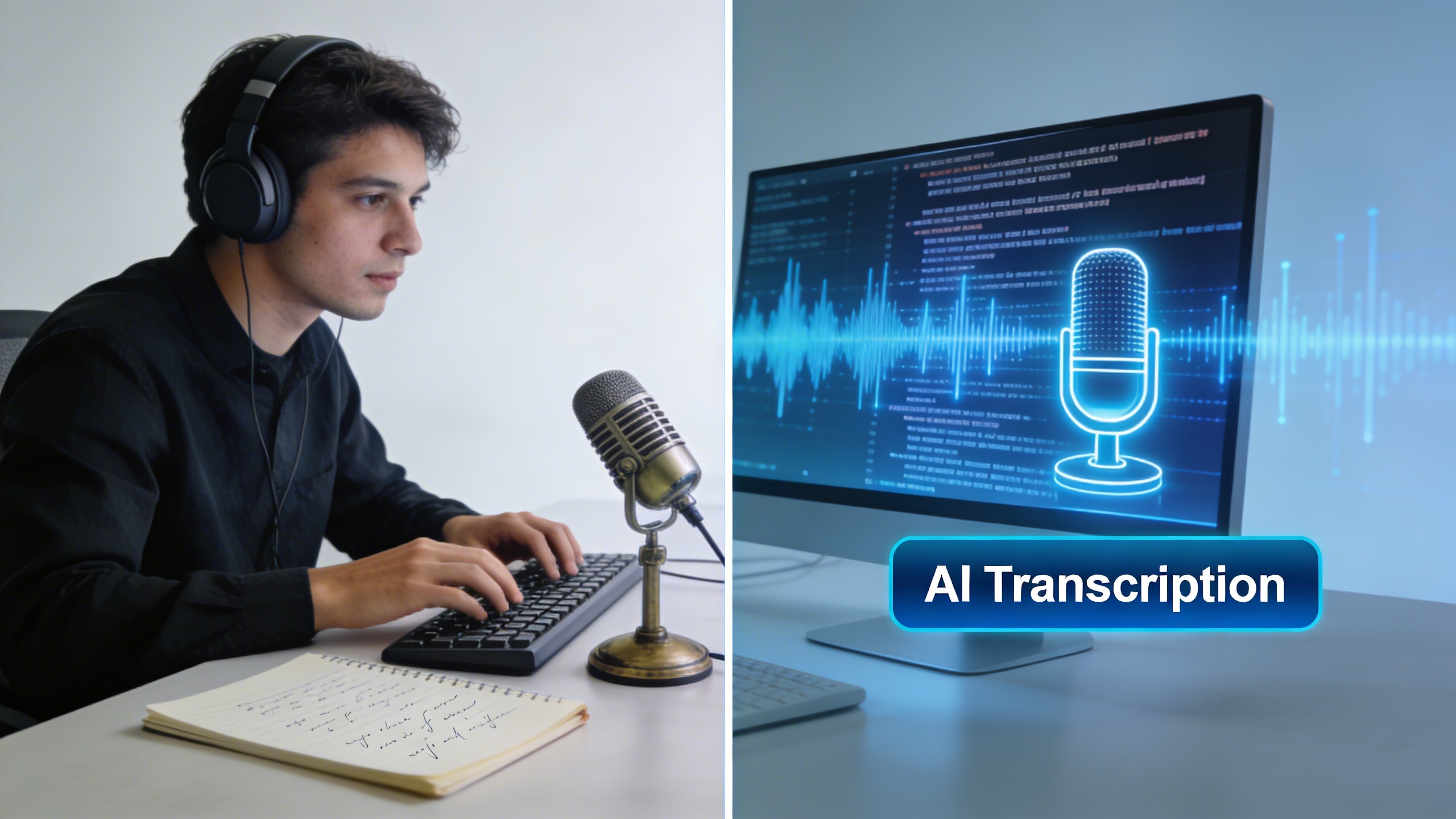
The fundamental choice in transcription from audio lies between human expertise and artificial intelligence capabilities. Human transcriptionists deliver exceptional accuracy rates of 95-99% for clear audio, particularly excelling with complex terminology, multiple speakers, and challenging audio conditions. They understand context, handle accents naturally, and can interpret unclear speech through experience.
AI audio transcription has revolutionized the industry with rapid processing speeds and cost-effectiveness. Modern AI systems achieve 85-95% accuracy on high-quality audio, with some advanced platforms reaching near-human performance levels. The technology processes hours of content in minutes rather than the hours required by human transcriptionists.
| Factor | Human Transcription | AI Transcription |
|---|---|---|
| Accuracy | 95-99% | 85-95% |
| Speed | 4-6x audio length | Real-time to 2x speed |
| Cost | $1-3 per minute | $0.10-0.50 per minute |
| Complex audio | Excellent | Good to excellent |
Real-Time vs Batch Processing Options
Real-time transcription transforms spoken words into text instantly as they’re spoken, making it invaluable for live events, meetings, and accessibility purposes. This technology powers live captions for broadcasts, provides immediate meeting notes, and supports real-time communication for hearing-impaired individuals. The trade-off involves slightly reduced accuracy compared to post-processing methods, but the immediate availability often outweighs this limitation.
Batch processing handles pre-recorded audio files, allowing for higher accuracy through multiple processing passes and human review when needed. This approach suits interviews, recorded lectures, podcasts, and any scenario where immediate results aren’t critical. Batch processing typically delivers superior accuracy rates and can handle longer audio files more efficiently.
Many modern platforms, including Sozai, offer both real-time and batch processing capabilities, allowing users to choose the appropriate method based on their immediate needs and accuracy requirements.
Specialized Transcription Categories
Medical transcription requires specialized knowledge of anatomical terms, pharmaceutical names, and clinical procedures. These services employ transcriptionists with healthcare backgrounds who understand complex medical terminology and maintain strict confidentiality standards required by HIPAA regulations.
Legal transcription demands precision in capturing depositions, court proceedings, and legal consultations. Legal transcriptionists understand courtroom procedures, legal terminology, and the critical importance of verbatim accuracy in legal contexts where every word can impact case outcomes.
Academic transcription serves researchers, students, and educational institutions by converting lectures, interviews, and research recordings into searchable text. These services often include features like speaker identification, timestamp insertion, and formatting for academic citations.
Multilingual transcription addresses the growing need for audio to transcript conversion across different languages. Advanced services offer both transcription within single languages and translation services that convert speech from one language into text in another. This capability proves essential for international businesses, research projects, and global content creation.
Each specialized category combines domain expertise with transcription audio video technology to deliver results that meet industry-specific standards and requirements.
How AI Audio Transcription Technology Works
Modern AI audio transcription technology represents a sophisticated convergence of machine learning, signal processing, and computational linguistics. Understanding how these systems convert spoken words into written text reveals both their remarkable capabilities and current limitations in handling diverse audio content.
Machine Learning and Speech Recognition
At the core of audio to text transcription lies deep neural networks that process sound waves through multiple computational layers. These systems analyze audio frequencies, identifying phonemes—the smallest units of speech—and mapping them to corresponding letters and words. Deep learning models train on vast datasets containing millions of hours of recorded speech, learning to recognize patterns across different speakers, accents, and speaking styles.
The neural network architecture typically includes recurrent neural networks (RNNs) or transformer models that process sequential audio data. When you upload audio for transcription from audio files, the system first converts the analog sound waves into digital spectrograms—visual representations of frequency changes over time. These spectrograms feed into the neural network, which predicts the most likely text sequence based on acoustic patterns it has learned during training.
Natural Language Processing in Transcription
Advanced transcription audio video systems combine speech recognition with natural language processing to improve accuracy and readability. NLP components analyze context, grammar, and semantic meaning to correct initial transcription errors and format the output appropriately. This includes adding punctuation, capitalizing proper nouns, and distinguishing between homophones based on contextual clues.
Language models trained on extensive text corpora help predict word sequences that make linguistic sense. When the acoustic model suggests multiple possible words, the language model evaluates which option fits best within the sentence structure and overall meaning. This dual approach significantly improves the quality of audio to transcript conversion compared to purely acoustic-based systems.
Accuracy Improvements and Limitations
Modern AI transcription services achieve impressive accuracy rates, often exceeding 95% for clear audio with standard accents. However, several factors significantly impact performance. Background noise remains a persistent challenge—systems struggle to separate speech from ambient sounds, music, or overlapping conversations. While noise reduction algorithms help, they cannot completely eliminate interference in complex audio environments.
Accent and dialect recognition has improved dramatically through diverse training datasets, but regional variations and non-native speakers still present difficulties. AI audio transcription systems perform best with mainstream accents and may require specialized models for specific regional dialects or languages.
Technical limitations include handling rapid speech, mumbled words, and domain-specific terminology. Medical, legal, and technical jargon often requires specialized models trained on industry-specific vocabulary. Additionally, speaker identification in multi-person conversations remains challenging, though some systems now offer basic speaker diarization capabilities.
Real-time processing demands significant computational resources, creating trade-offs between speed and accuracy. Cloud-based solutions like Sozai leverage powerful server infrastructure to deliver fast, accurate transcription while maintaining user-friendly interfaces across devices.
Despite these limitations, continuous improvements in model architecture, training techniques, and computational power steadily enhance transcription quality, making AI-powered solutions increasingly reliable for professional and personal use cases.

Choosing the Right Audio Transcription Service
Selecting the optimal audio to text transcription service requires careful evaluation of multiple factors that directly impact your workflow efficiency and results quality. The right choice depends on your specific needs, budget constraints, and security requirements.
Key Features to Evaluate
Accuracy rates serve as the primary benchmark when comparing transcription services. Professional-grade platforms typically achieve 85-95% accuracy for clear audio, while advanced AI audio transcription systems can reach 98% accuracy under optimal conditions. However, accuracy varies significantly based on audio quality, speaker accents, and background noise levels.
Turnaround time represents another critical factor. Automated services deliver transcription from audio files within minutes, while human transcriptionists may require 24-48 hours for complex projects. Consider your deadlines when weighing speed against potential accuracy trade-offs.
File format compatibility ensures seamless integration with your existing workflow. Look for services supporting common formats like MP3, WAV, M4A, and FLAC. Advanced platforms also handle transcription audio video files including MP4, MOV, and AVI formats, eliminating the need for separate conversion tools.
Speaker identification capabilities become essential for multi-participant recordings such as interviews or meetings. Premium services can distinguish between different voices and label speakers accordingly, significantly improving transcript readability and usability.
| Feature | Basic Services | Professional Services | Enterprise Solutions |
|---|---|---|---|
| Accuracy Rate | 80-85% | 90-95% | 95-98% |
| Turnaround Time | 5-15 minutes | 1-4 hours | Real-time to 2 hours |
| File Formats | MP3, WAV | 10+ formats | All major formats |
| Speaker ID | No | Yes | Advanced labeling |
Pricing Models and Cost Considerations
Understanding pricing structures helps optimize your transcription budget. Per-minute pricing typically ranges from $0.10 to $3.00 per audio minute, depending on service quality and turnaround requirements. This model works well for occasional users or projects with varying monthly volumes.
Subscription-based pricing offers predictable monthly costs, usually starting around $15-30 for basic plans with limited minutes, scaling up to $100+ for unlimited professional accounts. Heavy users often find subscriptions more economical than pay-per-use models.
Volume discounts become available for bulk processing, with some services offering 20-40% savings for commitments exceeding 1,000 minutes monthly. Enterprise clients may negotiate custom pricing based on specific requirements and integration needs.
Hidden costs can impact your budget significantly. Watch for charges related to rush delivery, custom formatting, multiple speaker identification, or premium support. Factor these potential expenses when comparing total ownership costs across different providers.
Security and Privacy Requirements
Data protection standards vary dramatically between transcription services, making security evaluation crucial for sensitive content. Look for providers implementing end-to-end encryption during file upload, processing, and storage phases.
Compliance certifications indicate serious commitment to data protection. HIPAA compliance becomes mandatory for healthcare-related audio to transcript conversions, while SOC 2 Type II certification demonstrates robust security controls for business applications.
Data retention policies directly affect long-term privacy. Some services automatically delete files after 30 days, while others maintain copies indefinitely unless explicitly requested for removal. Review these policies carefully, especially when processing confidential information.
Geographic data storage locations matter for organizations subject to regional privacy regulations like GDPR or data sovereignty requirements. Ensure your chosen service processes and stores data in compliant jurisdictions.
For users seeking reliable AI-powered transcription with strong privacy protections, Sozai offers local processing capabilities that keep sensitive audio files on your device while delivering professional-quality results.
Access controls and user management features become essential for team environments. Look for services offering role-based permissions, audit trails, and secure sharing capabilities to maintain data integrity across your organization.
Best Practices for High-Quality Audio Transcription
Achieving accurate audio to text transcription requires careful attention to both technical preparation and strategic workflow management. Whether you’re working with professional services or AI-powered solutions, following established best practices significantly improves transcription accuracy and reduces post-processing time.
Optimizing Audio Quality for Better Results
The foundation of successful transcription from audio begins with recording quality. Clear audio dramatically improves transcription accuracy, often making the difference between 95% and 99% precision rates.
Record in quiet environments whenever possible, positioning microphones 6-8 inches from speakers’ mouths. Use external microphones rather than built-in device mics, as they capture cleaner sound with less background interference. For multi-speaker scenarios, consider lapel microphones or boundary microphones that can isolate individual voices.
Audio format selection impacts transcription quality significantly. Record in uncompressed formats like WAV or high-bitrate MP3 files (320 kbps minimum) to preserve audio clarity. Avoid heavily compressed formats that may introduce artifacts affecting speech recognition algorithms.
When dealing with existing recordings, apply noise reduction carefully. Light filtering can improve clarity, but over-processing may distort speech patterns that AI audio transcription systems rely on for accurate conversion.
Preparing Files and Managing Expectations
Proper file preparation streamlines the transcription audio video workflow and sets realistic expectations for output quality. Before submitting files, review recordings for technical issues like volume inconsistencies, audio dropouts, or severe background noise.
Organize files with descriptive naming conventions that include date, participants, and content type. This systematic approach helps during the review process and ensures proper handling of multiple recordings.
Speaker identification becomes crucial for multi-participant recordings. When possible, have speakers introduce themselves at the beginning, or provide a speaker list with voice descriptions. This preparation helps transcription services accurately attribute dialogue and maintain conversation flow.
Set realistic expectations based on audio complexity. Simple conversations between two speakers in quiet environments typically achieve 95-98% accuracy, while conference calls with multiple participants may reach 85-92% accuracy. Technical discussions with specialized terminology require additional review time regardless of the transcription method used.
Consider using tools like Sozai for real-time transcription needs, which can provide immediate audio to transcript conversion while maintaining speaker identification and timestamp accuracy.
Post-Transcription Review and Editing
Quality assurance processes transform raw transcripts into polished, professional documents. Establish a systematic review workflow that addresses both accuracy and formatting consistency.
Begin with a complete playback review, comparing audio against the transcript line by line. Focus particularly on proper nouns, technical terms, and numbers, which often require manual correction even with advanced AI systems.
Implement timestamp verification for time-sensitive content. Accurate timestamps enable quick navigation to specific discussion points and support compliance requirements in legal or medical contexts.
Develop formatting standards that match your organization’s needs. Consistent speaker labeling, paragraph breaks, and punctuation improve readability and professional presentation. Consider whether verbatim transcription or intelligent formatting better serves your intended use case.
Create quality checkpoints throughout longer transcription projects. Regular reviews prevent errors from accumulating and maintain consistent standards across team members handling different sections.
Document common correction patterns to improve future transcription accuracy. This feedback loop helps refine recording techniques and service selection, ultimately reducing editing time for subsequent projects.
Free vs Paid Audio Transcription Solutions
Selecting between free and paid audio to text transcription solutions requires careful evaluation of your specific needs, accuracy requirements, and long-term goals. Understanding the trade-offs between cost and functionality will help you make an informed decision that aligns with your transcription objectives.
When Free Tools Are Sufficient
Free transcription tools work well for basic personal use cases where perfect accuracy isn’t critical. These solutions typically handle simple audio to transcript conversions for casual note-taking, personal reminders, or draft content creation. Most free services provide adequate results for clear, single-speaker recordings in quiet environments.
However, free tools often impose significant limitations. File duration restrictions commonly cap uploads at 30-60 minutes, while accuracy drops substantially with background noise, multiple speakers, or technical terminology. Many free services also lack advanced features like speaker identification, timestamp insertion, or custom vocabulary support that enhance transcription quality.
Professional Service Advantages
Professional transcription services deliver superior accuracy rates, typically achieving 95-99% precision compared to 70-85% for free alternatives. These platforms excel at transcription audio video processing with multiple speakers, technical content, and challenging audio conditions. Advanced ai audio transcription engines used by professional services incorporate sophisticated noise reduction, speaker diarization, and context-aware processing.
Premium services also provide essential business features including secure file handling, API integrations, batch processing capabilities, and customizable output formats. Professional platforms often support longer files, faster processing times, and specialized industry vocabularies for medical, legal, or technical content. Tools like Sozai offer enterprise-grade security and accuracy for business transcription needs across multiple platforms.
ROI Considerations for Business Use
Calculating return on investment for transcription from audio services requires examining both direct costs and time savings. A professional service costing $0.10 per minute might seem expensive compared to free alternatives, but the time saved on manual corrections often justifies the expense. Consider that editing a poorly transcribed 60-minute file can require 2-3 hours of manual work.
For businesses processing substantial audio content, professional services provide measurable value through improved workflow efficiency. Higher accuracy reduces editing time, while features like automated formatting and speaker identification eliminate manual post-processing steps. Companies handling sensitive content also benefit from compliance features and data security guarantees that free services cannot provide.
Scalability becomes crucial as transcription needs grow. Free tools rarely support bulk processing or integration with existing workflows, creating bottlenecks as volume increases. Professional services offer APIs, team collaboration features, and automated workflows that scale seamlessly with business growth, making them essential for organizations with expanding transcription requirements.
Future of Audio Transcription Technology
The landscape of audio to text transcription is evolving rapidly, with breakthrough innovations reshaping how we capture, process, and utilize spoken content. These advancements promise to transform industries from healthcare to entertainment, making transcription more accurate, accessible, and intelligent than ever before.
Emerging Trends and Innovations
Real-time multilingual translation represents one of the most exciting developments in transcription audio video technology. Modern systems can now simultaneously transcribe and translate spoken content across dozens of languages, enabling seamless global communication in live meetings and international conferences. This capability extends beyond simple word conversion, incorporating cultural context and idiomatic expressions for more natural translations.
Voice biometrics and advanced speaker identification are revolutionizing how we handle multi-speaker environments. These systems can distinguish between individual voices with remarkable precision, automatically tagging speakers and maintaining conversation threads even in complex audio environments. This technology proves invaluable for legal proceedings, medical consultations, and business meetings where speaker attribution is crucial.
Emotion recognition and sentiment analysis are emerging as powerful additions to traditional transcription from audio services. These features can detect vocal stress, excitement, or concern, providing context that pure text cannot convey. Healthcare providers use this technology to better understand patient communication, while customer service teams leverage emotional insights to improve response strategies.
Integration with Other AI Tools
The future of ai audio transcription lies in seamless integration with broader AI ecosystems. Smart workflow automation can now trigger specific actions based on transcribed content, such as automatically scheduling follow-up meetings mentioned in recordings or generating task lists from project discussions.
Natural language processing integration enables transcription services to extract key insights, create summaries, and identify action items without human intervention. This capability transforms raw audio to transcript conversion into actionable intelligence, saving hours of manual review time.
Knowledge management systems increasingly incorporate transcription technology to make organizational audio content searchable and discoverable. Employees can now find specific information from years of recorded meetings, training sessions, or presentations using simple keyword searches.
Industry Evolution and Opportunities
Accessibility improvements continue driving innovation, with new features supporting hearing-impaired users through enhanced visual representations of audio content. Real-time captioning systems now provide contextual information about background sounds, speaker emotions, and conversation dynamics.
Edge computing capabilities are enabling offline transcription processing, crucial for sensitive industries requiring data privacy. Healthcare organizations and legal firms can now process confidential audio locally while maintaining the accuracy of cloud-based systems.
The integration of augmented reality with transcription technology opens new possibilities for immersive experiences, where spoken words appear as contextual overlays in real-world environments, enhancing learning and communication across various professional settings.